
Introduction
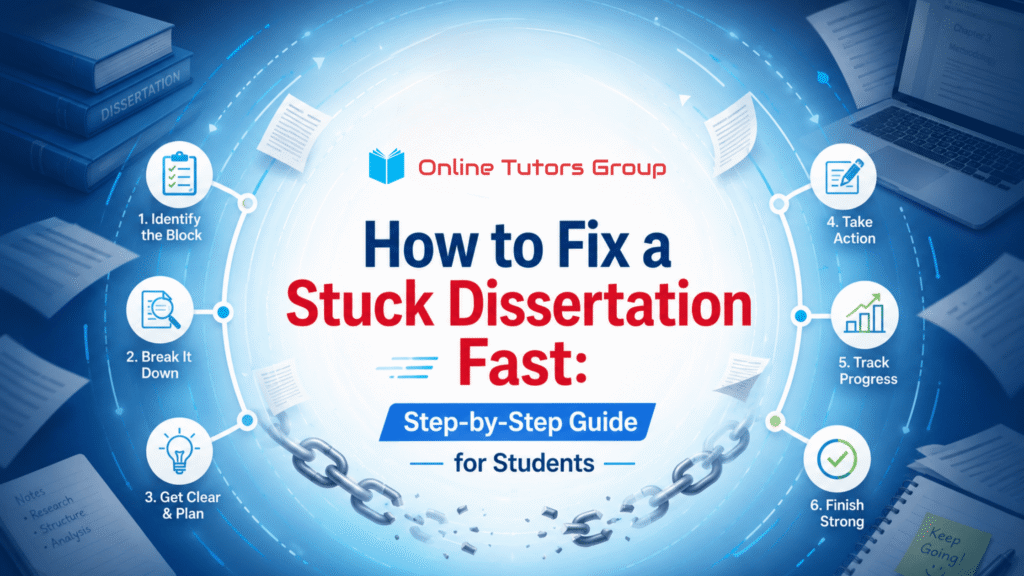
A dissertation can feel like a major academic challenge, especially when progress suddenly stops. Many students begin with strong motivation but later face confusion, lack of direction, or difficulty organizing their research. This situation is very common and does not mean failure. It usually means the project needs a clear structure and a practical restart method.
If your work is stuck, the good news is that you do not need to start from scratch. With the right steps, it is possible to regain control and move forward quickly. Many students also search for the best dissertation writing help when they feel overwhelmed, but before taking external support, there are effective strategies you can apply on your own to restart your work.
Step 1: Identify Exactly Where You Are Stuck
Before making progress, it is important to understand the exact reason why your dissertation has stopped moving forward. Most students get stuck due to unclear topic direction, weak research questions, difficulty writing certain chapters, or poor time planning. Sometimes, a lack of motivation also slows down progress.
Take the time to clearly note the area where the problem is happening instead of trying to fix everything at once. Once the main issue is identified, it becomes much easier to take the next step in the right direction.
Step 2: Break the Dissertation into Small Parts
One major reason students feel stuck is that they see the dissertation as one large and overwhelming document. This creates mental pressure and makes writing difficult. Instead, it is better to divide the dissertation into smaller sections like the introduction, literature review, methodology, findings, and conclusion.
Each chapter can be further broken down into smaller tasks or subtopics. This method reduces pressure and makes the writing process more manageable and structured.
Step 3: Revisit Your Research Question
A weak or unclear research question often causes the entire dissertation to slow down. It is important to go back and check whether your research question is too broad, too narrow, or not aligned with your available data. If it does not match your direction, small changes may be needed.
A clear research question works like a foundation for your entire dissertation. When it is strong and focused, writing becomes easier and more consistent across all chapters.
Step 4: Rebuild Your Chapter Structure
A disorganized structure can also stop your progress. Creating a clear outline for each chapter helps bring direction back to your work. For example, the introduction should include background and objectives, while the methodology should explain research design and data collection methods.
Do not focus on perfect wording at this stage. The main goal is to restore a logical flow so that each section connects smoothly to the next.
Step 5: Start Writing in the Easiest Section
If you are stuck, avoid starting with the introduction, as it can often be difficult to write first. Instead, begin with the section you understand best, such as methodology, findings, or a literature review.
Starting with the easier parts builds confidence and the writing flow. Once progress begins, it becomes easier to return to the introduction and conclusion with a clearer mindset.
Step 6: Use Simple Daily Writing Targets
Large writing goals often slow students down because they find it difficult to complete. Instead, it is better to set small daily targets such as writing 300–500 words or completing one subtopic at a time.
These smaller tasks are easy to achieve and help maintain steady progress. Even short writing sessions each day can gradually move the dissertation forward strongly and consistently.
Step 7: Review and Fix One Section at a Time
Editing the entire dissertation at once can create confusion and delay progress. A better approach is to complete one section, review it, and then move on to the next part. This keeps the work organized and is easier to manage.
Working step by step also helps maintain clarity in writing and reduces the chance of repeated mistakes across different chapters.
Step 8: When to Consider External Academic Support
Sometimes, even after trying different methods, students still struggle with time pressure or complex research topics. In such situations, many students search for the best dissertation writing help to get guidance on structure, editing, or research support.
If external help is used, it should focus on improving understanding and guiding the writing process rather than replacing your own work. Proper support can help you move forward when you are completely stuck.
Step 9: Rebuild Writing Confidence
A stuck dissertation can affect confidence and make writing feel stressful. One way to overcome this is by reviewing what has already been completed instead of focusing only on unfinished parts. Even little progress should be acknowledged.
Writing one paragraph daily or revisiting completed sections can slowly rebuild confidence. Avoid comparing your work with others, as every dissertation follows a different pace.
Conclusion:
A stuck dissertation is a common situation and can be resolved with the right approach. By identifying the issue, breaking the work into smaller sections, and following a structured restart method, progress can be made without restarting everything from the beginning.
Many students also look for the best dissertation writing help when they feel blocked, but applying these practical steps often restores direction and momentum. With consistent effort and a clear plan, completing a dissertation becomes a manageable and achievable task.